What is Linkup?
Summary
Section titled “Summary”Most modern web applications consist of many services.
Engineers often need a complete copy of a these services to develop and test changes on, even though they only change one or two services at a time.
Linkup reduces the cost of running a complete system copy by combining shared, persistent services with changed services that can run locally or in temporary “preview” environments.
Each “virtual copy” of a system is called a linkup session.
The Problem
Section titled “The Problem”Let’s start with an example setup that linkup aims to help with:
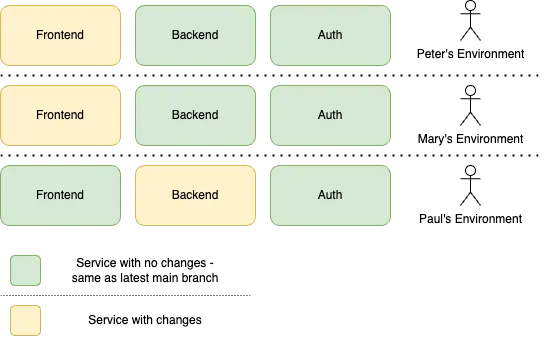
To run Peter, Mary, and Paul’s environment, they would each need deployed copies of all necessary services: frontend, backend, and auth. Traditionally, that would mean 9 running services.
Linkup’s Solution
Section titled “Linkup’s Solution”Linkup answers the question “Why can’t we share the unchanged services?”. In this case, we would need 6 running services:
- 1 for the shared unchanged auth service
- 1 for the shared unchanged backend service
- 1 for the shared unchanged frontend service
- 3 changed services
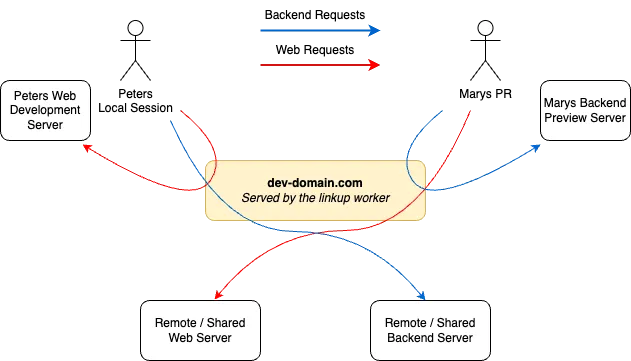
For example, Peter here can use a local copy of their web development server, but they can use the remote / shared backend server without having to run anything locally.
Mary’s pull request can deploy a preview of their backend that can be accessed through the remote / shared web server.
Benefits
Section titled “Benefits”There are several reasons why sharing services like this can benefit engineering organisations.
- The overall cost of running many environments for engineers is lower.
- The speed at which environments can be created at is often faster.
- Linkup also allows engineers to connect locally running services to shared environments, so most development setups become cheaper and easier to run.